Runaway is a two-wheeled alarm robot. You set it from a phone but must catch it and press its button to stop it. Students who kept missing their 9 a.m. classes built it with an ultrasonic obstacle sensor.
Silencing your alarm now starts with chasing it around the room.
Kazutaka Kurihara's controller prints conductive touch buttons and wiring into one 3D-printed plate. Players wear conductive finger sleeves. AI can change the layout and generate print files, including versions with 16–18 buttons.
Printing the controls together somehow added equipment to the player's fingers.
Maker DocJade developed a custom file system to load the game Factorio from a large collection of floppy disks. Files are split across disks, and the user must manually swap in the disk requested during loading.
With only one drive, swapping disks becomes the main bottleneck. Even after optimizing the system to reduce swaps, loading the game takes about a week.
To start a game, you have to keep swapping floppy disks by hand. The setup has practically become a separate game of its own.
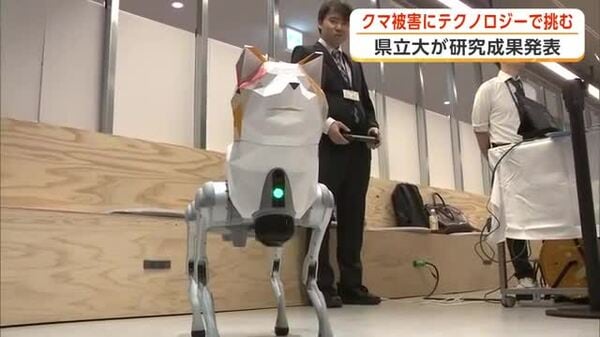
Hacchan, a four-legged robot with an Akita dog face, was presented as a prototype for deterring bears. It makes lifelike dog-barking sounds. The researchers aim to have the robots patrol buffer zones and gather in groups to drive bears away when one is spotted.
The team at Akita Prefectural University presented the project on October 13. They are developing an AI-based system intended to respond to bear movements without direct human control.
Its face looks like a dog from an old low-polygon video game, while the rest of its body is exposed machinery. The humans may be startled before the bears are.
A Halloween skull uses a camera to spot people in costumes, then generates a dad joke tailored to what they are wearing. It sends the camera image to Claude and reads the generated joke aloud using text-to-speech.
Liz Clark of Adafruit published the build guide in 2025. The project is intended to entertain costumed guests at a Halloween party.
Approach a spooky skull and, instead of scaring you, it tells a dad joke. That's one unusually cheerful Halloween monster.
A team taped a funnel to the end of a robot arm in an attempt to make it juggle. Their plan was to throw a ball upward and catch it in the same spot, alternating between two balls. Rather than use a camera to track the balls, they planned to repeat the same throw and catch motion.
Mandy Meindersma and two teammates worked on the idea at a September 2026 hackathon. They report that it was much harder than expected.
At the end of a precision robot arm is a funnel held on with tape. That's an unexpectedly charming meeting of industrial robotics and kitchen hardware.
A digital clock displays numbers by using air pressure to deform silicone membranes. Removing air from a 3D-printed segment creates a visible line, and multiple segments form digits. Valves control the display, which can update once per second.
The creator, the YouTube channel soiboi soft, built the air-powered display to retain its state through air pressure. It can also show timers and stopwatch readings.
Instead of simply lighting up a digit, this clock pumps air to reshape silicone. Every passing second calls for a little pneumatic construction job.
Brux built a working miniature bowling alley inspired by Wii Sports. Three lanes reset their own pins and return the balls. The lanes can also feature walls, ramps and a loop-the-loop. Gears and linkages power the mechanism, with many parts 3D-printed.
Turning video-game bowling into a physical game means building the pin-resetting machinery too. And adding a loop-the-loop.
Matthew Lim made objects from flat materials using kirigami cuts and folds, including a phone grip and a table. The table uses plywood and 3D-printed hinges to lock into different shapes.
Instead of assembling a table, you almost unfold it.
A 15-year-old student hand-wound 250 meters of wire for EFNMRQC, a home quantum computing project using Earth's magnetic field. So far the maker reports detecting an NMR signal, not working quantum computation.
The first step toward futuristic computing is winding a huge amount of wire.
The Tragic Mouse is an iPhone case that also works as a functional computer mouse.
It was created by Matty Benedetto of Unnecessary Inventions, a maker who builds deliberately unnecessary products. The creator's official page lists the device as operational.
Your phone already does so much, but apparently its case also needed to become a computer mouse. Now your phone has another job on the desk.
An exhibit at NT Tokyo 2026 featured a 'half-human pen plotter,' a drawing machine that deliberately leaves part of the work to a person.
The small XY stage moves the paper while a human presses a pen down and lifts it up. The drawing itself is difficult to see while working, but the user can feel the paper moving through the pen and hear the mechanism.
The creator is Naan. See the 'Naanさん「半人力ペンプロッタ」' section of the linked firsthand event report.
A machine meant to automate drawing still needs a human assigned to raise and lower the pen. The person has effectively become a printer component.


















Silencing your alarm now starts with chasing it around the room.