Hacchan, a four-legged robot with an Akita dog face, was presented as a prototype for deterring bears. It makes lifelike dog-barking sounds. The researchers aim to have the robots patrol buffer zones and gather in groups to drive bears away when one is spotted.
The team at Akita Prefectural University presented the project on October 13. They are developing an AI-based system intended to respond to bear movements without direct human control.
Its face looks like a dog from an old low-polygon video game, while the rest of its body is exposed machinery. The humans may be startled before the bears are.
T1 is a robot that can transform itself between humanoid and robot-dog forms. It normally moves upright using two legs and wheels; when it reaches a step, it transforms into a quadruped, crosses the obstacle on four legs, and then stands back up as a humanoid.
The robot is about one meter tall and weighs roughly 16 kg. It was developed by China's Qiyuan Robotics and went on sale from 19,999 yuan, with shipments scheduled from October 1.
Humanoid robots and robot dogs are already two major robot genres. T1 apparently decided there was no need to choose just one.
Petoi's mini robot dog Quaddle can keep walking even when flipped upside down. In the video, three Quaddles are also fixed together with blocks so they behave like one larger robot, then perform a backflip in unison.
A tiny quadruped walking around without seeming to care which side is up already gives it a peculiar creature-like quality. Combining three units turns them into something resembling one larger quadruped that rotates as a single body, making the demo increasingly unconcerned with both orientation and robot count.
First it keeps walking upside down as if nothing happened; then three of them combine for a backflip. This robot dog seems remarkably unconcerned with either up and down or how many bodies it has.
Dynamic Creatures launched in September 2026 to turn advanced mobile robots into interactive characters for theme parks, hotels and other guest-facing spaces. The company is Boston Dynamics' official entertainment and hospitality partner and plans to build both character systems based on existing robotic platforms and fully custom machines.
Its target sits between fixed animatronics and task-oriented service robots. Public examples show familiar-looking quadruped robotics transformed with fur, faces and character design into something closer to a roaming theme-park creature. After solving difficult locomotion, one of the next engineering problems is apparently making the machine look huggable.
After years of improving robot-dog locomotion, the next technical requirement turns out to be “make it fluffier.” Robotics has successfully advanced all the way to costume design.
Wheeled delivery robots struggle with stairs, curbs and thresholds. R-dog tackles those obstacles by using a quadruped body that can step over them, while also carrying deliveries and potentially displaying advertising on its sides.
The current product page adds another layer: pet the robot's head and a sensor makes its tail wag. The dog-like body is not only functional; the design also commits to dog behavior for charm.
Four legs make practical sense, but then the design continues to “well, a dog should wag its tail.” That's serious commitment to the role.

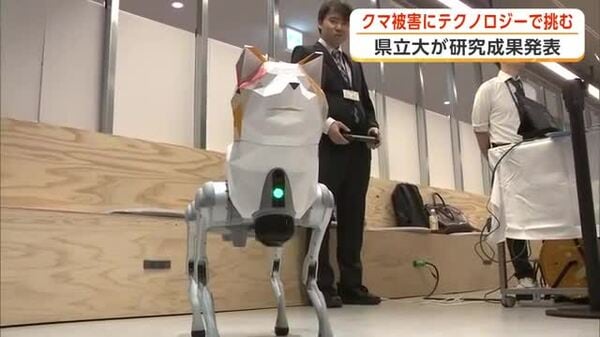








Its face looks like a dog from an old low-polygon video game, while the rest of its body is exposed machinery. The humans may be startled before the bears are.