A hand-cranked pencil sharpener moves a blade back and forth along curved tracks while advancing and rotating the pencil in small steps. Chronova Engineering devised an intermittent gear mechanism to make the pencil turn while producing a concave tip.
The mechanism works, but sharpening is slow and labor-intensive rather than practical.
Two elaborate motions, one tiny pencil tip. Ordinary sharpeners suddenly seem remarkably efficient.
This homebuilt drone flies using a single propeller mounted above a finned body, rather than the multiple rotors commonly seen on small drones.
Its maker, jyjblrd, has published modified flight-controller and motor-controller firmware, along with 3D design files for the body and propeller parts, on GitHub.
Most small drones spread the work across several rotors. This design gives the job to just one—and moves the engineering challenge somewhere else.
Maker PETCraft tested how many discarded plastic bottles it takes to produce one kilogram of 3D-printing filament: thirteen 5-liter bottles, one 10-liter bottle, two 8-liter bottles and one 1.5-liter bottle, or 17 in total.
The bottles were heat-smoothed, cut into strips with a homemade cutter, then drawn through a heated nozzle and wound into filament. Printing with the result is a future step.
Recycling one kilogram of filament required collecting and processing 17 enormous bottles. Saving material turned into a surprisingly large manufacturing project.
Smart-home control panels often consist of plain buttons and icons. Anton Frolov took a different approach: he turned a hand-drawn illustration of his house into a smart-home dashboard.
A fireplace flickers in the illustration, garden lights glow, and an air conditioner animates in response to the real appliances' states. The artwork changes between day and night. Frolov commissioned illustrator Owen Yeconiel and connected the drawing to Home Assistant. A TV displays the whole house, while phones and computers provide controls.
When the family didn't want to use the smart-home controls, the solution was to illustrate the entire house—and animate its appliances. The interface redesign became an art commission.
To reduce the temptation to pick up his smartphone, Kevin Noki built a large handset styled after a 1980s mobile phone. It is not a standalone cellular phone: it connects to an existing smartphone via Bluetooth to handle calls.
After an initial Bluetooth setup produced poor audio, Noki switched to a dedicated hands-free module. He shaped a foam mockup before 3D-printing the final enclosure, allowing the real phone to stay out of his hands during calls.
To stop reaching for one phone, he built a second phone. And the new phone still depends on the original one.
Shintaro Tamefusa built a rig that makes a cold croquette appear piping hot: as he pulls it apart with both hands, he steps on a foot pump and sends smoke through a tube behind the food.
Smoke from a smoke machine is stored in a sealed container and pushed through the tube by the foot pump. When he compared the effect with an actually heated croquette, the real one was painfully hot but produced barely visible steam, while the cold croquette with added smoke looked much hotter.
Instead of heating the food, the machine adds only the visual evidence of heat. Somehow the cold croquette ends up looking hotter than the real hot one.
Maker gangi-man 3D-printed an assassin's teapot, a vessel that can pour two different drinks from the same spout. It has separate internal chambers, and covering one of two air holes in the handle determines which liquid flows out.
The maker aimed for a design suitable for everyday use and spent about 14 hours printing it. After tackling leaks around an acrylic lid, the finished teapot successfully dispensed Calpis Soda and Amino Supli separately.
A vessel with a sinister name gets a painstaking redesign for everyday use. The demonstration drinks, meanwhile, are entirely innocent.
A child was frightened of the family's robot vacuum and would turn it off whenever it started moving. To help the two get along, the maker fitted the vacuum with a motorized tail, inspired by the child's love of cats.
A servo pulls fishing line to bend the tail, with randomized speed and angles to make it feel more lifelike. The tail alone did not hold the child's attention for long, so the maker also added a fluffy cover. The child began petting the vacuum and offering it stuffed animals.
The fluffy makeover makes the vacuum worse at returning to its charging dock, but much better at being loved. The modification succeeded at its actual goal.
Daniel Simu, creator of the full-size acrobatic robot Acrobot, has built a miniature version called Micro Acrobot. The desk toy combines MakerBeamXS aluminum profiles, 3D-printed parts and an acrylic panel, and is offered as a DIY kit.
It has the same number of joints and the same hands and feet as its larger counterpart, so it can be posed for similar tricks, including handstands. Unlike the large robot, the miniature has no motors and must be posed by hand.
Shrink an acrobatic robot into a toy and it can no longer perform by itself. Now the human has to do the work of making the robot strike a pose.
A motor-free, semi-automatic playing-card launcher fires one card each time its trigger is pulled. It uses a suction cup of the kind found on toy projectiles to pick up a single card at a time.
A catapult-style mechanism launches the cards, which are positioned at a slight angle to help them fly straight. Creator tekelili refined the design through several prototypes and demonstrated a card sticking into a cucumber.
An entire mechanism picks up and launches individual playing cards, all without a motor. A harmless deck of cards has somehow acquired the machinery of a projectile launcher.
Google's Gboard team has unveiled Gboard Carousel, a DIY keyboard that places keys on moving conveyor belts. Rather than moving your hand across a stationary keyboard, you wait for the desired key to pass under your finger and press it at the right moment.
Each belt holds 29 keys, including direct access to uppercase and lowercase letters. The design supports one-handed input. Google does not plan to sell it, but has published open-source plans for anyone who wants to build one.
If moving your finger to the keys is too much trouble, why not make every key move instead? Typing becomes a game of catching the right letter as it passes by.
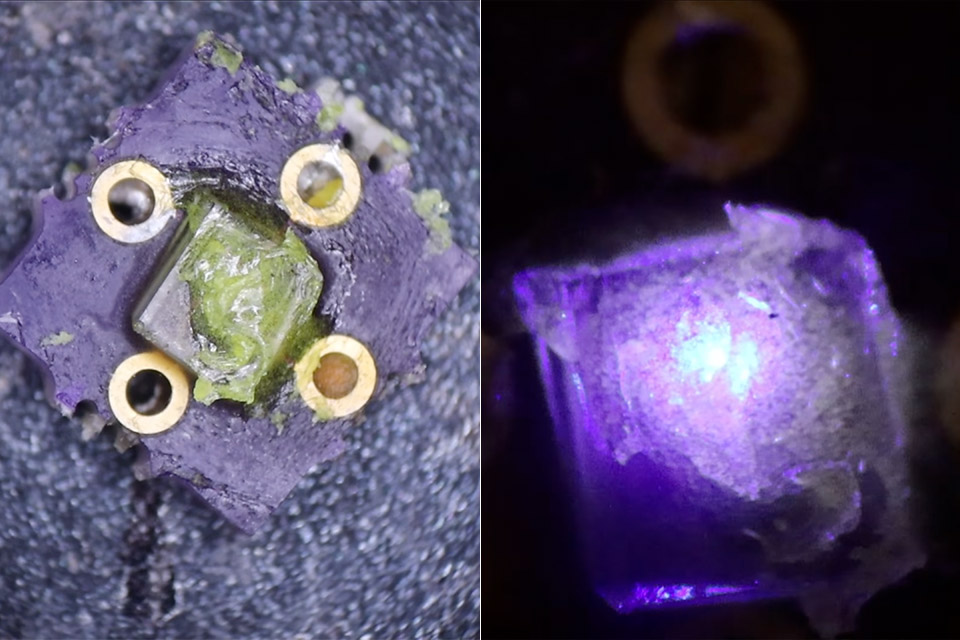
Dr. Semiconductor, who built a semiconductor cleanroom in a backyard shed, has fabricated working LED chips using his home equipment. Rather than buying LEDs and building a circuit around them, the project processes the light-emitting semiconductor itself, packages the resulting chips on circuit boards, and finishes them as white LEDs.
The process starts with a gallium-nitride LED wafer on sapphire. An ultraviolet laser bought on eBay is used for machining, metal contacts are deposited, the wafer is cut into individual chips, and the dies are bonded to custom boards. Phosphor is then added to turn the blue emission into white light.
Most electronics projects begin by buying an LED for pocket change. This one begins by building enough semiconductor-fabrication capability to manufacture the LED itself. The starting point of the project is absurdly far upstream.























Two elaborate motions, one tiny pencil tip. Ordinary sharpeners suddenly seem remarkably efficient.