A Mini 4WD model car has been modified with a mechanism that makes it jump. Creator Zeru designed custom parts for 3D printing and uses rubber bands, rather than an additional powered actuator, as the energy source for the jump.
After several prototypes and adjustments, the car successfully reached a jump height of roughly 40 centimeters using ten rubber bands. The creator sums up the motivation simply: jumping is romantic.
A toy built to race forward gets ten rubber bands so it can develop performance in an entirely new direction. The car has started aiming for the sky.
A motor-free, semi-automatic playing-card launcher fires one card each time its trigger is pulled. It uses a suction cup of the kind found on toy projectiles to pick up a single card at a time.
A catapult-style mechanism launches the cards, which are positioned at a slight angle to help them fly straight. Creator tekelili refined the design through several prototypes and demonstrated a card sticking into a cucumber.
An entire mechanism picks up and launches individual playing cards, all without a motor. A harmless deck of cards has somehow acquired the machinery of a projectile launcher.
The Fully Automated Motomura Shichimi Sorting Machine separates the chili peppers from shichimi, a Japanese seven-spice blend, to produce ichimi, or single-spice chili pepper seasoning. It is designed to sort different types of ingredients.
The machine also incorporates Pockét YUZAN, a large language model that predicts the comments of Kaibara Yuzan, a gourmet character from the manga Oishinbo. Its creators, the five-member group Bishoku Club, work on recreating the labor-intensive food preparation depicted in the manga using modern technology.
See the Motomura Shichimi sorting machine section in the linked report.
Turning seven-spice seasoning back into one-spice seasoning is already a lot of work. This machine also asks AI to predict what a famously demanding gourmet would say about the result. The preparation is becoming an epic undertaking.
Google's Gboard team has unveiled Gboard Carousel, a DIY keyboard that places keys on moving conveyor belts. Rather than moving your hand across a stationary keyboard, you wait for the desired key to pass under your finger and press it at the right moment.
Each belt holds 29 keys, including direct access to uppercase and lowercase letters. The design supports one-handed input. Google does not plan to sell it, but has published open-source plans for anyone who wants to build one.
If moving your finger to the keys is too much trouble, why not make every key move instead? Typing becomes a game of catching the right letter as it passes by.
Labububot is a spherical robot made by reconstituting twelve Labubu heads into a single form at the MIT Media Lab. With faces pointing in every direction, the project uses its deliberately strange appearance as a playful critique of social robots.
It was created by Miranda Lin Li, Jake Read, and Dimitar Dimitrov. MIT Media Lab describes the result as a “Frankenstein's Monster of pop culture iconography.”
Robots often get faces to make them feel friendlier. This one multiplies that idea by twelve and somehow crosses the line back into monster territory.
PickentCode built a computer powered entirely by a small Stirling engine heated by an alcohol lamp. Instead of a wall outlet or battery, the flame keeps a generator turning to power an ESP32-C3 and a small OLED display.
A 16-key keypad lets the machine run CHIP-8 games and custom programs. To stay within the tiny power budget, wireless features are disabled and the processor speed is reduced when full performance is not needed.
Turning on this computer starts with lighting a flame rather than pressing a power button. If you want to keep playing, keeping the fire alive becomes part of using the machine.
A fully FDM-printed mechanical calculator performs addition and multiplication by setting digits and turning a hand crank. It uses no electronics; rotations through printed gears perform the calculation, including a mechanical carry mechanism.
3D All Workshop spent about two months developing the design. Because FDM-printed gears are sensitive to tolerances, the mechanism went through roughly one hundred design iterations before it worked reliably.
A cheap calculator can produce the answer instantly, but this one required roughly a hundred mechanical redesigns just to make the gears cooperate. Building the calculator is vastly more work than doing the calculation.
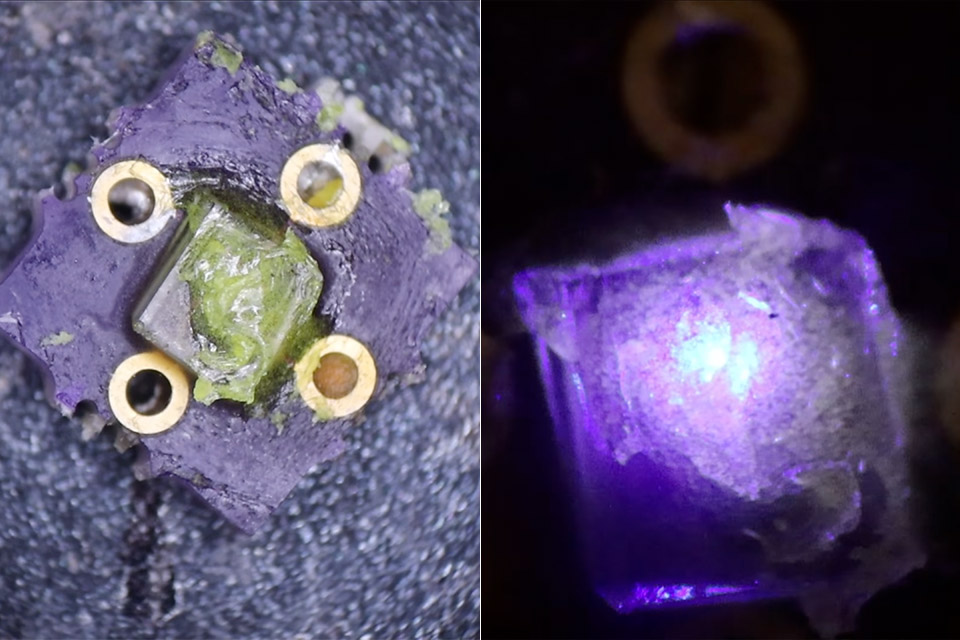
Dr. Semiconductor, who built a semiconductor cleanroom in a backyard shed, has fabricated working LED chips using his home equipment. Rather than buying LEDs and building a circuit around them, the project processes the light-emitting semiconductor itself, packages the resulting chips on circuit boards, and finishes them as white LEDs.
The process starts with a gallium-nitride LED wafer on sapphire. An ultraviolet laser bought on eBay is used for machining, metal contacts are deposited, the wafer is cut into individual chips, and the dies are bonded to custom boards. Phosphor is then added to turn the blue emission into white light.
Most electronics projects begin by buying an LED for pocket change. This one begins by building enough semiconductor-fabrication capability to manufacture the LED itself. The starting point of the project is absurdly far upstream.
A light-field display has been built using a rapidly spinning drum perforated with holes and stationary LED matrix panels behind it. Each hole reveals a different view of the rendered object, so the image changes with viewing angle and appears three-dimensional.
The prototype uses three LED panels and has an effective resolution of roughly 100 by 48 pixels per eye. Its viewing range covers only part of a full circle, but the display is already capable of running DOOM. It was built by AncientJames.
Building a mechanical 3D display was not enough; the roughly 100-by-48-pixel image also had to run DOOM. Even when the screen becomes volumetric, DOOM remains the final test.
El Pulpo Magnifico is a roughly 8.5-meter-tall mobile kinetic sculpture shaped like a giant octopus. Its eight tentacles and eight eyes move, while flames shoot from its extremities. The exterior is built from reclaimed metal and repurposed objects including kitchenware.
A control panel operates its movement and fire effects, and the machine carries about 200 gallons of propane. It was built by Duane Flatmo, Jerry Kunkel, Will Startare and their crew.
A giant octopus could have stopped at being a sculpture, but this one also drives, moves its tentacles and eyes, and carries enough propane to breathe serious fire. The least necessary octopus features received the most engineering.
The Laundry Chair is made for clothes that have been worn but are not yet ready for the laundry. Its clothes-hanging section can rotate behind the backrest, so garments can stay on the chair while the seat remains usable.
The hanging section rotates on a ball-bearing mechanism. Swing it forward to drape clothes over it like a drying rack, then move it behind the chair to clear the seat. Simone Giertz developed the product from an earlier prototype through Yetch Studio.
Instead of trying to stop people from leaving not-quite-dirty clothes on a chair, this chair is designed to be their proper home. The furniture changes so the habit does not have to.
Dadlexa is a homemade smart speaker that records a child's question, sends the audio to the father's phone, and plays back the father's recorded reply. It behaves like a commercial voice assistant when activated, but the intelligence answering general questions is the father himself rather than AI.
The device detects its wake phrase, records the question, and sends it through Telegram. When the father replies with a voice message, the device downloads and plays it. Music commands can also play files stored locally on the device. It was created by Sean Clark.
A modern smart speaker was built from scratch, only for the intelligence layer to be outsourced entirely to Dad. Since a real person answers the questions, it is arguably an unusually capable assistant.




















A toy built to race forward gets ten rubber bands so it can develop performance in an entirely new direction. The car has started aiming for the sky.